



The Saudi Investment Bank
Our Vision
To offer the simplest and most accessible products and services to each of our customers.
Our Mission
Towards our customers
- We make banking simple and accessible for each of our customers.
- We are flexible, adaptive, and responsive to deliver what suits our customers.
- We listen to our customers and understand their needs and preferences in order to evolve and improve.
Towards our employees
- We value ideas, inputs, and initiatives.
- We empower our staff to bring out their best and go the extra mile.
- We recognize individual contribution and we support individual development.
- We enhance team spirit, which allows us to collectively build the smartest solutions.
The Bank commenced operations in 1977 pursuant to a Royal Decree dated June 22, 1976. It concentrated on medium-term financing of industrial projects. In 1983, the Bank adopted the SAIB name and moved into full commercial banking. The Al Asalah Islamic Banking brand, through which the Bank provides Shariah-compliant products and services, was launched in 2006. Islamic principles lie at the heart of all the Bank’s operations and our Shariah Committee assure adherence to Shariah principles in our product development.
SAIB provides wholesale, retail, and commercial banking products in the Kingdom of Saudi Arabia, both Shariah-compliant and traditional. In addition to personal banking, the Bank services the government, quasi-government, corporate, and MSME sectors. Our finance operations offer a range of non-interest-bearing banking products including Murabaha, Istisna’a, and Ijarah. Our product portfolio also includes several treasury and investment banking products.
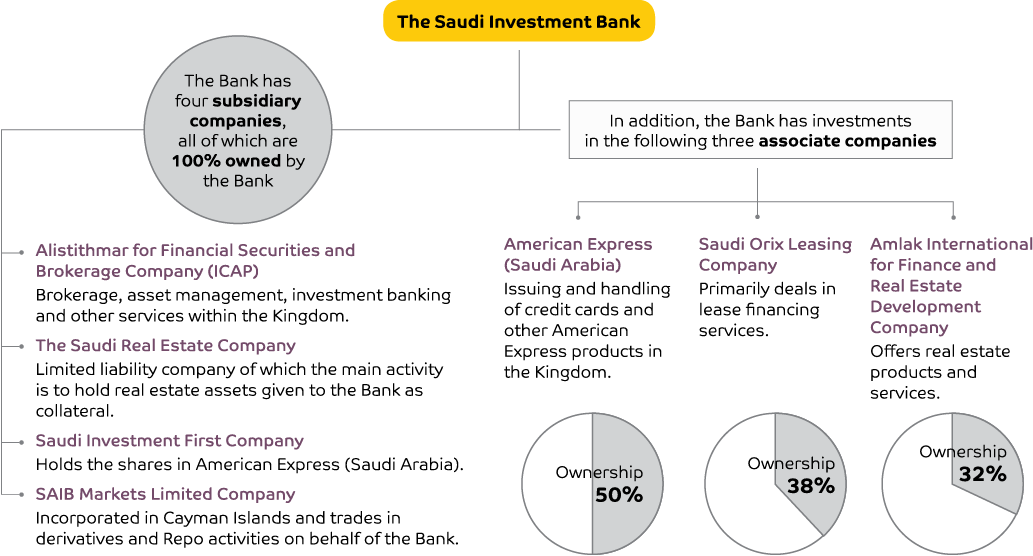
Our joint ventures and subsidiaries expand our range of products and services to include investment banking, share trading, asset management, leasing finance, mortgage finance, brokerage services, corporate finance services, and credit card services.
The Bank’s network includes 52 branches, 48 of which offer Shariah-compliant banking services and 10 ladies’ sections. As of December 31, 2019, the Bank operated a network of 393 ATMs and over 9,300 POS terminals.

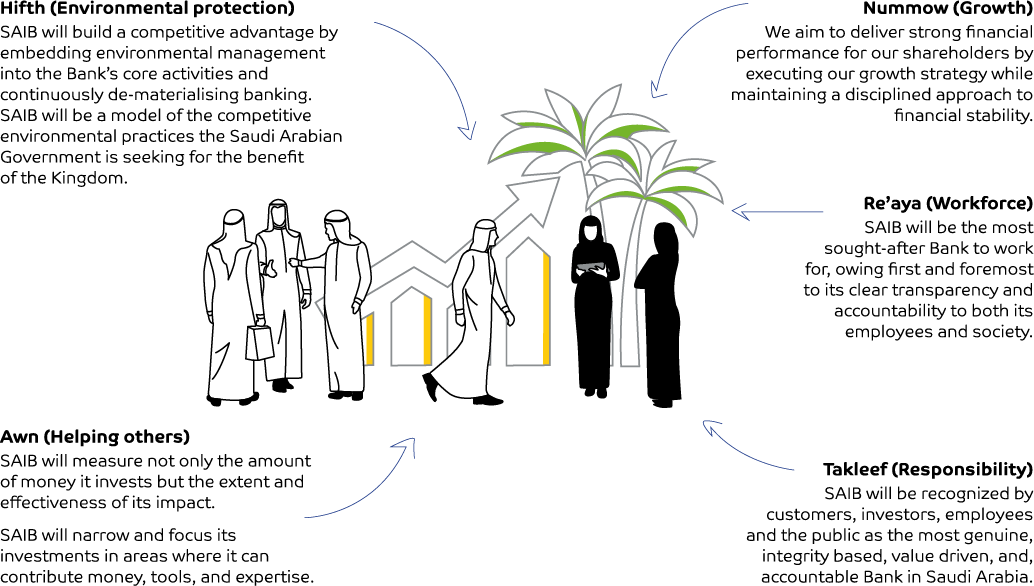
SAIB has a sustainability framework including five Islamic principles which have been crafted to integrate our commercial responsibilities with our social and environmental responsibilities. They also reflect Islamic principles of good governance and management.
Vision 2030 is the framework that drives the aspirations, policies, and plans of the Kingdom today. The Vision is founded upon three themes: a vibrant society, a thriving economy, and an ambitious nation. Many of the goals of Vision 2030 are either directly connected with finance or have a financial implication and thus, SAIB plays a role in the Vision with its contributions.

A vibrant society
Vision goals |
SAIB contribution |
|
| Moderation, tolerance, excellence, discipline, equity and transparency | The Islamic principles of Hifth, Nummow, Re’aya, Takleef, and Awn | |
| Receiving 30 million Umrah visitors a year | Financing of general infrastructure and tourism infrastructure | |
| 40% of citizens to exercise once a week | Fitness club memberships, promoting sports teams, awareness campaigns, “Flexx Bike”, and promoting healthy diet | |
| Three KSA cities among top 100 in the world | Urban infrastructure project finance | |
| Resource efficiency, pollution reduction, and nature conservation | GHG emissions tracking, evaluate EMS, UNPRI, and Building Management System | |
| 5% increase in home ownership by 2020 | Al Asalah home finance, and key strategic target focusing on retail mortgages | |
| Empowering educational, cultural, and entertainment institutions | Community investment, Kidzdomm, and Kidzania activities for children |

A thriving economy
Vision goals |
SAIB contribution |
|
| Reduce unemployment to 7% |
Youth employment programmes such as Fast Track, Graduate programme and young hires | |
| Small businesses contribute 35% to GDP, financial institutions allocate up to 20% funding to SMEs | Focus on increasing lending | |
| 30% female employment | 20.9% female employees, 40.8% of new hires women | |
| Improve living and working conditions for non-Saudis | Expatriate personal finance | |
| Increasing environmental friendliness in oil and gas, mining, tourism and leisure; digitalization of economy, 75% localization of oil and gas, 9.5 GwH renewable energy |
A targeted 10% of loan portfolio for financing of environmentally friendly, low carbon activities | |
| Private sector to contribute 65% of GDP, FDI 5.7% of GDP, within top 10 in Global Competitiveness Index | Specialised products and services, ICAP a signatory to the United Nations Principles for Responsible Investment, GRI Community member, signatory to the UN Global Compact | |
| Rank 25 in logistics performance index, invest in infrastructure | Infrastructure project finance guided by equator principles |

An ambitious nation
Vision goals |
SAIB contribution |
|
| Reach top 5 in E-government Index | Ranked 7th in Hawkamah ESG Pan Arab index in 2017 for disclosure of ESG issues | |
| Interactive online and smart engagement methods | Focus on promoting cashless transactions, efficient e-commerce services, contributions with Fintechs to improve customer journey and product offering, annual and sustainability reporting | |
| Households save 10% of income leading to greater financial independence | Murabaha Deposit, awareness campaigns via the Bank’s social media channels | |
| Corporate social responsibility | Health, financial literacy, charity events, WooW Alkhair programme, etc. | |
| 1/3 of NPO projects have deep and measurable social impact; one million volunteers by 2020 | Community investment, active volunteer programme and volunteering policy |