



Strategic Framework
2019 marks the completion of the Bank’s operative strategic plan based on the theme “Building on Strengths” that was initiated in 2015. The plan is customer-centric, based on the achievements and lessons learnt from the previous strategic plan.
Building on strengths: methodology for development
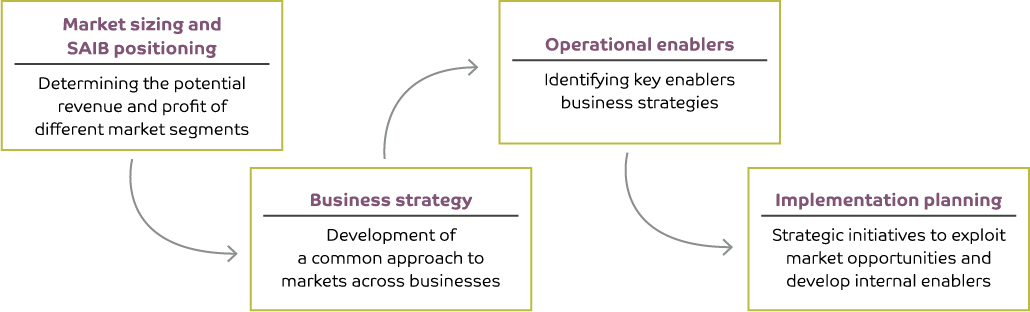
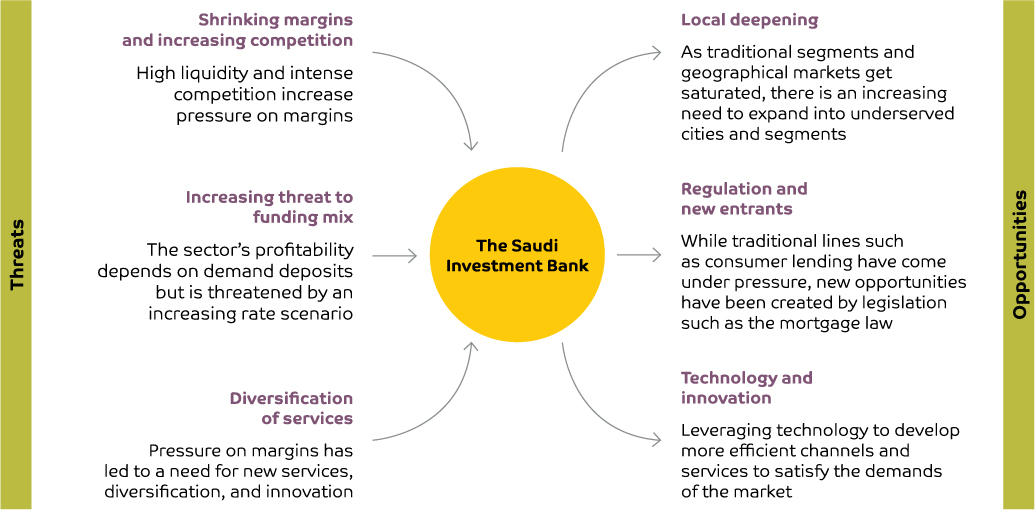
During the development of the strategic plan, which utilised inputs from meetings, surveys, and staff workshops, SAIB identified trends in the Kingdom’s banking sector. From these trends, SAIB was able to identify threats and opportunities in the market, product segments, customer segments, geographical markets, and channels for expansion.
The main objectives for financial performance are to increase revenue while significantly increasing profitability and maintaining the capital adequacy ratio.
By studying the developments in the operating environment and the results of stakeholder engagement combined with the understanding of the Bank’s position within the industry, SAIB has determined the broad strategic imperatives for it to focus on and identified sub-focus areas within those imperatives. For 2020, these will be reviewed to craft a new strategic framework for the Bank.

Growing volume profitably
- Organic growth in business volumes
- Expanding footprint in both conventional and alternative channels
- Diversification of products and customer segments
- Improving operational efficiency
- Ensuring adequate capital to comply with regulatory changes
SAIB had initially set an asset growth target rate of 8%, which is above the market rate. However, there are many factors to consider in achieving this target and a balance needs to be reached. More profitable areas, such as demand deposits, need to be identified and similar to its counterparts, the Bank has to increase fee-based income.
A balance has to be maintained between risk and profitability, and the Bank has to adhere to various rules such as capital adequacy requirements and regulatory provisions like IFRS 9 and Basel III.
As transaction volumes expand, so too do operating costs and these need to be controlled to ensure that profitability increases. Non-performing loans can be minimized through careful credit control.
Read more »

Developing systems and processes
- Agile approach to project delivery
- Implementation of a strategically planned digital transformation programme to leverage technology
- Improvements to policies, procedures, mechanisms, and systems for implementation
- Centralised processing for standardising and economies of scale
- Use of robotics
- Cyber security vigilance
- Systems upgrades/integration
The strategic plan calls for the agile development of systems and processes to support operational initiatives. Supporting processes have to be developed for key elements of the plan. For example, to develop cross-selling opportunities that leverage the specialised products offers by subsidiaries, organizational silos had to be broken down so that cross-selling could be implemented across SAIB’s organizational units and corporate lines.
Furthermore, the Sustainability Dashboard Management System (SDMS) was developed to ensure the provision of accurate and timely sustainability information at the required level of detail.
Read more »

Leveraging relationships
- Communication with investors
- Understanding the customer better through data analytics
- Streamlining customer onboarding process
- Personalising customer experience/Creating “moments of truth”
- Addressing customers’ issues swiftly and fairly
- Monitoring customer and business partner satisfaction
- Collaboration through partnerships/joint ventures
- Building long-term mutually beneficial relationships with business partners
Developing lasting and mutually beneficial relationships with customers, investors, and business partners is critical to the continued growth and prosperity of SAIB. To this end, SAIB is transparent and honest in its communications with its stakeholders and applies the most effective and appropriate channels of communication.
Technology has been leveraged to enable a diverse range of touchpoints with customers in addition to the traditional brick and mortar branches; Customers interact with the Bank via the internet, smart devices, ATMs, Cash Deposit Machines, IVR, and self-service kiosks. When expanding the Bank’s reach to regions of the Kingdom, the most customer centric and cost-effective channels have to be selected.
Read more »

Broadening product and market portfolio
- Evaluating changing customer needs
- Identifying and concentrating on more profitable product segments
- Balancing the needs of different market segments
- Focus on more profitable types of customers
- Streamlining the product development process
- Transitioning from commoditised to innovative and differentiated products
- Promoting sales orientation
- Focus on effective sales strategies such as cross-selling and joint calling
- Brand strategy to support overall strategy
- Developing market fact base
As today’s markets evolve and customers become increasingly technology savvy, new products and services are being introduced that are also increasingly digital in nature in both the personal banking and corporate banking segments. Lucrative opportunities also exist in market niches such as affluent banking.
Read more »

Building people skills
- Aligning the HR strategy with the new corporate strategy
- Motivation and retention
- Health and safety of employees
- Training and skills development in key aspects
- Engagement with staff
- Employee satisfaction through rewards and recognition
The development of SAIB’s employees is a continuous ongoing process. This ensures that employees are up to date with the evolving landscape of the market, the latest technologies, and current customer needs and the role they play in the future sustainability of the Bank. The Bank’s recruitment process is enhanced to ensure that the best local talented people are selected and placed in the most appropriate positions to leverage their abilities.
SAIB is committed to Saudization and increasing the proportion of female employees. The Bank strives to help its female staff balance their career growth and their family responsibilities and is conscious of human rights considerations and health and safety issues.
Read more »

Serving the society and the environment
- Identifying issues related to our business and impact
- Addressing impact through the value chain
- Incorporating Environmental, Social and Governance (ESG) considerations in strategies and operations
SAIB understands its contribution to the national agenda and to our stakeholders and while the Bank is focused on maximizing shareholder returns, it also seeks to fulfil its social responsibilities as a responsible corporate. Every effort is taken to minimize the Bank’s environmental footprint in its activities; to achieve this, an Environmental Management System (EMS) has been implemented that adheres to the
ISO 14001 standard.
The Bank carries out many social programmes with educational, health, and charity objectives. Furthermore, the Bank’s strategies align to the goals of Vision 2030.
Read more »