Corporate Governance is established to ensure the fair treatment and balancing of interests of the various stakeholders in the Bank, such as shareholders, employees, customers, suppliers, financiers, the government, regulatory entities, and the community.
Sound Corporate Governance Practices can benefit the Bank in several ways:
- Improved performance and profitability
Strong governance practices enable more effective decision-making by the Board and the Executive Management, which can lead to improved performance that drives increases in revenue and reductions in costs.
- Mitigation in risk of failure
Effective and diligent governance can prevent corporate scandals, fraud, or any civil and criminal liability for the Bank, while enhancing its reputation as a self-policing, responsible bank worthy of continued investment.
- Protection of minority shareholders
Good Governance Practices ensure the rights of minority shareholders are protected regarding the right to seek information, voice an opinion, and vote in General Assembly Meetings.
Governance structure
SAIB’s governance structure is established upon three pillars: establishing strategic direction; executing strategy and managing risks; and stewardship through conformance with policy and established procedures, rules, and practices.
The Bank’s governance structure, underpinned by policies, procedures, and practices, helps to ensure good governance. The values, ethics, and integrity of the Bank help to ensure the implementation of the governance rules and procedures.
The Bank’s governance framework is defined in the Corporate Governance Manual, along with the Board and Executive Management structures, key policies, guidelines and control functions, and the duties of Board members and the restrictions placed on them. The Manual is available to the general public via the Bank’s website.
Policies relating to corporate governance
SAIB complies with the Principles of Corporate Governance for Banks Operating in Saudi Arabia as issued by the Saudi Central Bank (SAMA) in March 2014, as well as the Corporate Governance Guidelines included in the Rules Governing the Companies in the Kingdom of Saudi Arabia issued by the Capital Market Authority on May 20, 2019 and the Basel Corporate Governance Principles for Banks.
The Corporate Governance Manual of the Bank has the purpose of institutionalising clear, robust, and effective Corporate Governance as the foundations for the Bank’s future market leadership, continued profitability, and long-term stability. The General Manager of Corporate Governance, overseen by the Board Corporate Governance Committee, is responsible for reviewing the contents of the Manual on an ongoing basis and ensuring it is up to date.
A full review of the Manual is conducted every two years by the General Manager of Corporate Governance under the supervision of the Board Corporate Governance Committee. The General Manager of Corporate Governance is accountable for ensuring that the Manual conforms to SAMA and CMA Guidelines for corporate governance and complies with the Principles for Enhancing Corporate Governance as published in the latest guidelines by the Basel Committee on Banking Supervision.
New Board members receive the appropriate induction and training upon appointment. All Board members receive a copy of the Bank’s Corporate Governance Manual, its appendices, and major policies including the Code of Conduct, Conflict of Interest policy, disclosure and transparency principles, and governance charter issued by CMA and SAMA’s Key Principles of Banks’ Governance.
SAIB’s Corporate Governance Framework is based on six Board committees, several Management committees, and Subcommittees. This governance structure is underpinned by a series of governance enablers which constitute the core to ensuring the required clarity and discipline of Good Corporate Governance: corporate values, organization structure design, policies and procedures, the Bank’s authorities’ matrix, and effective internal and external communication.
The Delegation of Authorities (DOA) matrix is regularly updated to accurately reflect internal approval controls.
The Board ensures the timely release of information as highlighted in the requirements of the SAMA and the CMA.
The Saudi Investment Bank committees’ structure and reporting lines
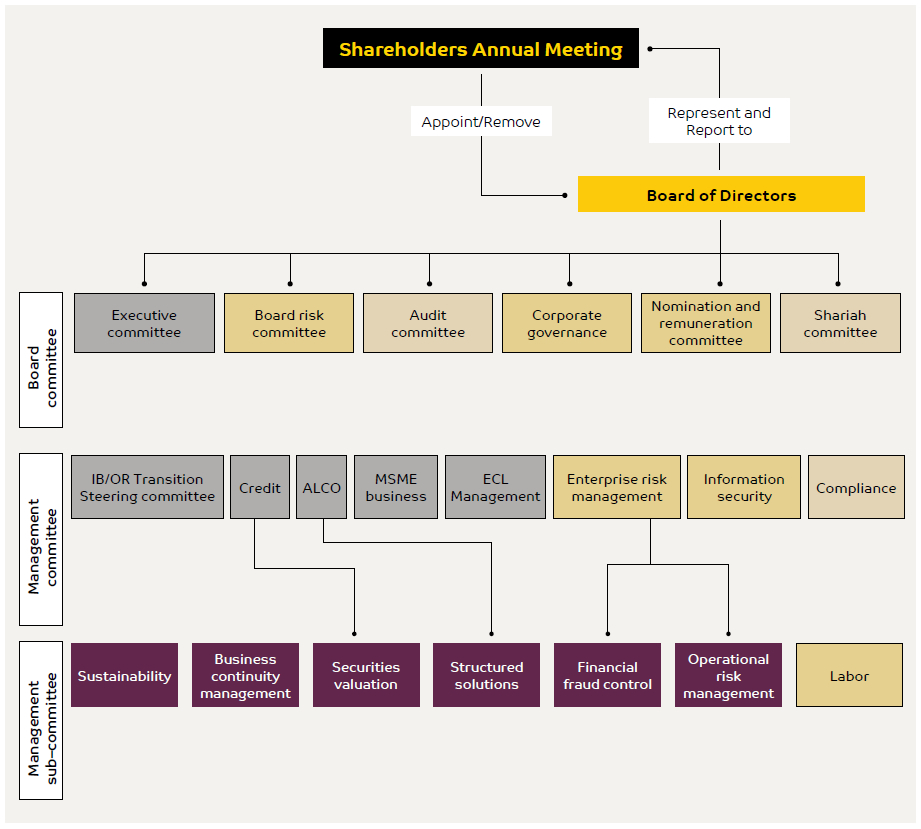
Board of Directors
The Board of Directors shall have the ultimate responsibility for the success, soundness, and solvency of the Bank, and is accountable for protecting depositors’ and shareholders’ funds. The members of the Board are responsible for the overall promotion and safeguarding of SAIB’s interests and upholding the highest standards of Corporate Governance across the Bank, its departments, and subsidiaries. The Board is responsible for setting the cultural and ethical tone of the Bank and developing its strategy, approving and overseeing implementation of the overall risk strategy, monitoring and overseeing Bank Managers’ performance, and organizational responsibilities such as the appointment and removal of the CEO and the Deputy CEO. They are accountable to the Organization’s shareholders.
Board composition
The Board of Directors comprises an appropriate number of Directors who have the relevant and diverse range of skills, expertise, experience, and background and can effectively understand the issues arising in the Bank’s business. The Chairman of the Board should be a non-executive member.
The Board Members are appointed by the General Assembly for a term of three years and should ideally serve for no more than 12 consecutive years as per SAMA’s Key Principles of Banks’ Governance. At least two of the Board members are independent and no more than two members can be executives of the Bank, in line with SAMA and CMA principles. Through a simple vote, the Board chooses a Non-Executive Director for the positions of Chairman of the Board and Vice-Chairman. Board members must inform the Chairman of the Board and the Corporate Governance Committee about their participation in other boards outside of the Bank and the executive positions they hold in other corporations; no Board member can serve on the board of another Saudi bank licensed and incorporated in the Kingdom of
Saudi Arabia to avoid conflict of interest, or on the boards of more than four other listed companies which must be disclosed to the Chairman of the Board and the Corporate Governance Committee.
The members of the Board must collectively possess the appropriate skills, expertise, and experience to ensure the proper oversight and Management of the Bank.
The Corporate Governance Manual defines the following Guidelines for the collective skill set of the Board:
|
Banking |
Commercial |
Regulatory |
Audit/Governance |
| Minimum number of members with appropriate skills and experience |
3-4 |
3-4 |
1-2 |
1-2 |
| Required experience |
- Over 15 years of domestic or international banking experience
- Previous experience
as a bank board member or bank CEO or bank senior level executive (direct CEO report)
|
Extensive commercial experience and network within
the Saudi market |
10-15 years of banking regulatory experience or previous experience as Central Bank regulatory senior or senior banking executive with deep regulatory focus |
- Over 15 years of audit, compliance, or governance-related experience
- Previously a Partner at
a Big four accounting firms, or an executive with senior audit, compliance, or governance role
|
| Additional requirements |
- At least one member with strong risk management expertise in banking
- At least one member with strong IT expertise in banking
|
Collective experience should cover key Saudi economic sectors such as oil and gas, construction, real estate, wholesale trade, and retail trade |
|
|
| Other relevant skills |
Possess relevant skills related to (but not limited to):
- Capital markets
- Financial stability issues
- Strategic planning
- Compensation
- Corporate governance
|
|
All Board members must maintain a high standard of honesty, integrity, competence, capability, financial soundness, and autonomy. They must always be diligent in conducting their directorship role and maintain loyalty to SAIB by prioritising the Bank’s interests and reputation. Each Board member has a responsibility to uphold the confidentiality of all information obtained over the course of their duties or seek the written permission of the Chairman of the Board to divulge confidential information during or after their tenure. Board members are prohibited from using any information for personal gain or for the benefit of any parties internal or external to the Bank.
The following table provides details about the members of the Board:
| Name |
Status |
Class |
Date of appointment |
Board meetings attended |
Other Board memberships |
| Mr. Abdallah Saleh Jum’ah |
Chairman |
Non-Executive |
February 14, 2010 |
5 |
- Board Member –
Hasana Investment Company
- Vice-Chairman – Zamil Industrial
- Board Member – Ma’aden
|
| Mr. Abdulaziz Al-Khamis |
Vice-Chairman |
Non-Executive |
February 14, 2007 |
5 |
- Vice-Chairman – Tawuniya Insurance Company
- Board Member – The United Insurance Company, Bahrain
- Board Member – Tabuk Cement Co.
- Board Member – The United Insurance Company, Bahrain
|
| Mr. Abdul Rahman Al-Rawaf |
Board Member |
Non-Executive |
February 14, 2010 |
5 |
|
| Dr. Fouad Al-Saleh |
Board Member |
Independent |
February 14, 2013 |
5 |
|
| Mr. Saleh Al-Athel |
Board Member |
Independent |
February 14, 2014 |
5 |
Board Member – Saudi Specialized Laboratories Company – Motabaqah |
| Mr. Mohammad Al-Ali |
Board Member |
Independent |
July 1, 2014 |
5 |
- Board Member – Saudi Energy Efficiency Services Company
- Board Member – Saudi Energy Efficiency Centre
|
| Mr. Mohammed Algrenees |
Board Member |
Non-Executive |
February 14, 2019 |
5 |
Board Member – Taiba Investment Company |
| Mr. Mohammed Bamaga |
Board Member |
Independent |
February 14, 2019 |
5 |
Board Member – The Saudi Federation for Cybersecurity, Programming and Drones |
| Mr. Yasser Aljarallah |
Board Member |
Independent |
February 14, 2019 |
5 |
- Board Member – Inma Medical Services LLC – KSA
- Co-Founder & Board Member – Tharwa Escan Investments LCC UAE
|
Board process
The Board shall hold the minimum number of meetings in accordance with the laws and regulations of Saudi Arabia and the meetings should be scheduled at the beginning of the year. Additional or extraordinary meetings can be arranged upon the request of the Chairman or two or more Board members. The agenda and information packs for Board meetings must be sent to members at least seven days in advance, with the exception of extraordinary meetings, in which case the materials should be sent as soon as possible. Board meetings can take place either face-to-face, by teleconference, or by video conference. The conditions for a Board meeting quorum are met when all the following conditions are satisfied:
- The Chairman or the Vice-Chairman of the Board is present at the meeting.
- At least five Board members attend in person or through representation by a Board member by means of a written notice. A Board member may not represent more than one member.
Board decisions are made through a simple majority of the votes of attending and represented Board members, with the deciding vote lying with the Chairman of the Board (or in his absence, the Vice-Chairman) in the event of a tie.
In 2020, five Board of Directors’ meetings were held as follows:
| Board member |
Board of Directors meetings attended |
|
April 9, 2020 |
July 9, 2020 |
July 28, 2020 |
October 14, 2020 |
December 20, 2020 |
| Mr. Abdallah Saleh Jum’ah |
|
|
|
|
|
| Mr. Abdulaziz Al-Khamis |
|
|
|
|
|
| Mr. Abdul Rahman Al-Rawaf |
|
|
|
|
|
| Dr. Fouad Al-Saleh |
|
|
|
|
|
| Mr. Saleh Al-Athel |
|
|
|
|
|
| Mr. Mohammad Al-Ali |
|
|
|
|
|
| Mr. Mohammed Algrenees |
|
|
|
|
|
| Mr. Mohammed Bamaga |
|
|
|
|
|
| Mr. Yasser Aljarallah |
|
|
|
|
|
Attendance of Board members in shareholders’ meetings held during the year is as follows:
One Ordinary General Assembly meeting was held in 2020.
| Date of meeting |
Members attended |
| April 21, 2020 |
Mr. Abdallah Saleh Jum’ah |
|
Mr. Abdulaziz Al Khamis |
|
Mr. Abdul Rahman Al-Rawaf |
|
Dr. Fouad Al-Saleh |
|
Mr. Saleh Al-Athel |
|
Mr. Mohammad Al-Ali |
|
Mr. Yasser Aljarallah |
|
Mr. Mohammed Bamaga |
Two Extraordinary General Assembly meetings were held in 2020.
| Date of meeting |
Members attended |
| March 23, 2020 |
Mr. Abdulaziz Al-Khamis |
|
Mr. Abdul Rahman Al-Rawaf |
|
Dr. Fouad Al-Saleh |
|
Mr. Saleh Al-Athel |
|
Mr. Mohammad Al-Ali |
|
Mr. Mohammed Algrenees |
|
Mr. Yasser Aljarallah |
|
Mr. Mohammed Bamaga |
| November 29, 2020 |
Mr. Abdulaziz Al-Khamis |
|
Mr. Abdul Rahman Al-Rawaf |
|
Dr. Fouad Al-Saleh |
|
Mr. Saleh Al-Athel |
|
Mr. Mohammad Al-Ali |
|
Mr. Mohammed Algrenees |
|
Mr. Yasser Aljarallah |
|
Mr. Mohammed Bamaga |
Board Secretary
The Board Secretary, who is appointed by the Board, must support the Chairman in ensuring the smooth functioning of the Board, including assisting in the logistics of the Board and Board Committee meetings, ensuring the meeting agenda and information pack is sent to members at least seven working days in advance, maintain detailed meeting minutes and decision records of the Board, including discussions, votes, objections, and abstentions from voting. The Secretary must distribute the final meeting minutes of Board meetings to all concerned parties no later than 10 working days from the meeting date. The Secretary is the authorised channel of communication and coordination with related departments to notify the Executive Management of all Board decisions and should follow up on those decisions and ensure their implementation by the Executive Management. The Secretary is responsible for ensuring the regulatory compliance of Board affairs.
Board committees
In compliance with Saudi Regulators and Basel Guidelines, the Board operates through six committees:
| Executive committee |
| Mr. Abdulaziz Al-Khamis – Chairman |
| Mr. Abdul Rahman Al-Rawaf |
| Dr. Fouad Al-Saleh |
| Mr. Saleh Al-Athel |
| Mr. Mohammed Algrenees |
Responsibilities:
- Supervises the credit and financial policies of the Bank.
- Oversees the Bank’s business strategy and its execution.
- Reviewing, monitoring, and approving key financial and non-financial business, and investment and operational decisions of the Bank within the authority defined by the Bank.
|
| Audit Committee |
| Mr. Mohammad Al-Ali – Chairman |
| Mr. Mohammed Bamaga |
| Mr. Abdullah Al-Anizi – Non-Board |
| Mr. Monahy Al-Moreikhy – Non-Board |
| Mr. Fayez Belal – Non-Board |
Responsibilities:
- Ensuring the quality and accuracy of financial accounting and Financial Statements including review of quarterly and annual Financial Statements and recommendation to the Board for approval.
- Supervising and reviewing the effectiveness and independence of Internal Auditors and External Auditors.
- Reviewing the Compliance and Anti-Money Laundering processes, including Code of Conduct and whistleblowing cases.
- Reviewing and evaluating the nature and effectiveness of the Bank’s Internal Control System including IT systems controls, their security, and their vulnerabilities.
- Recommending the appointment of External Auditors.
|
| Nomination and Remuneration Committee |
| Dr. Fouad Al-Saleh – Chairman |
| Mr. Abdulaziz Al-Khamis |
| Mr. Saleh Al-Athel |
| Mr. Abdul Rahman Al-Rawaf |
Responsibilities:
- Recommending to the Board of Directors appointments to membership of the Board in accordance with approved policies and standards.
- Reviewing on annual basis the requirements for the suitable skills for membership of the Board of Directors.
- Reviewing the structure of the Board of Directors and recommending changes thereto.
- Recommending to the Board the approval of the Bank’s compensation policy and amendments thereto, and other activities related to the Bank’s compensation policies
and guidelines.
- Approving the appointment and remuneration of Senior Executives of the Bank.
- Reviewing and supervising the implementation of succession planning and training of the Bank’s Board members, the CEO, and the direct reports of the CEO.
|
| Governance Committee |
| Mr. Yasser Aljarallah – Chairman |
| Mr. Mohammad Al-Ali |
| Mr. Saleh Al-Athel |
Responsibilities:
- Promoting and implementing best practices of governance by acting on behalf of the Board to ensure the implementation of these practices in all activities of the Bank.
- Monitors the Bank’s compliance with relevant local and international regulations.
- Monitors and guides the Governance function in the Bank, including its ownership of corporate governance policies, processes, and procedures.
|
| Risk Committee |
| Mr. Mohammed Algrenees – Chairman |
| Mr. Mohammad Al-Ali |
| Mr. Yasser Aljarallah |
| Mr. Mohammed Bamaga |
Responsibilities:
- Supervises the risk management activities of the Bank including market, credit, operational, and other risks.
- Setting the Bank’s Risk Management Strategy.
- Setting the Bank’s Risk Appetite framework and periodically reviewing the actual risk profile against the approved risk capacity and risk appetite.
- Reviewing the Internal Capital Adequacy Assessment Plan and the Internal Liquidity Adequacy Assessment Plan.
- Reviewing stress test results and review of the risks relating to the Bank’s subsidiaries and their potential impact.
|
| Shariah Committee |
| Dr. Mohamed Elgari – Chairman |
| Dr. Ibrahim Al-Lahim |
| Dr. Abdulaziz Almezeini |
Responsibilities:
- Providing Shariah opinions on submitted applications and related contracts and forms.
- Ensuring the Bank’s compliance with Shariah principles and decisions through the Shariah control function.
- Answers Shariah-related enquiries for the Bank and its customers.
|
The details of Board Committee meetings and attendance are provided in the following tables:
The Executive Committee held 13 meetings in 2020.
| Committee members |
Executive committee meetings attended |
January
27, 2020 |
February
24, 2020 |
March
30, 2020 |
April 27, 2020 |
May 17, 2020 |
June 29, 2020 |
July 27, 2020 |
August 31, 2020 |
September 28, 2020 |
October 26, 2020 |
November 30, 2020 |
December 2, 2020 |
December 28, 2020 |
| Mr. Abdulaziz Al-Khamis |
|
|
|
|
|
|
|
|
|
|
|
|
|
| Mr. Abdul Rahman Al-Rawaf |
|
|
|
|
|
|
|
|
|
|
|
|
|
| Dr. Fouad Al-Saleh |
|
|
|
|
|
|
|
|
|
|
|
|
|
| Mr. Saleh Al-Athel |
|
|
|
|
|
|
|
|
|
|
|
|
|
| Mr. Mohammed Algrenees |
|
|
|
|
|
|
|
|
|
|
|
|
|
The Audit Committee held five meetings in 2020.
|
Audit committee meetings attended |
| Committee members |
January 29, 2020 |
April 8, 2020 |
July 8, 2020 |
October 13, 2020 |
December 13, 2020 |
| Mr. Mohammad Al-Ali |
|
|
|
|
|
| Mr. Mohammed Bamaga |
|
|
|
|
|
| Mr. Abdullah Al-Anizi |
|
|
|
|
|
| Mr. Monahy Al-Moreikhy |
|
|
|
|
|
| Mr. Fayez Belal |
|
|
|
|
|
The Nomination and Remuneration Committee held five meetings in 2020.
|
Nominations and remuneration committee meetings attended |
| Committee members |
January 27, 2020 |
February 24, 2020 |
May 17, 2020 |
August
31, 2020 |
December 13, 2020 |
| Dr. Fouad Al-Saleh |
|
|
|
|
|
| Mr. Abdulaziz Al-Khamis |
|
|
|
|
|
| Mr. Abdul Rahman Al-Rawaf |
|
|
|
|
|
| Mr. Saleh Al-Athel |
|
|
|
|
|
The Governance Committee held two meetings in 2020.
|
Governance committee meetings attended |
| Committee members |
April 8, 2020 |
December 27, 2020 |
| Mr. Yasser Aljarallah |
|
|
| Mr. Mohammad Al-Ali |
|
|
| Mr. Saleh Al-Athel |
|
|
The Risk Committee held four meetings in 2020.
|
Risk committee meetings attended |
| Committee members |
March 15, 2020 |
June 14, 2020 |
September
16, 2020 |
November 23, 2020 |
| Mr. Mohammed Algrenees |
|
|
|
|
| Mr. Mohammad Al-Ali |
|
|
|
|
| Mr. Yasser Aljarallah |
|
|
|
|
| Mr. Mohammed Bamaga |
|
|
|
|
The Shariah Committee held four meetings in 2020.
|
Shariah committee meetings attended |
| Committee members |
February 27, 2020 |
July 14, 2020 |
September
3, 2020 |
December 16, 2020 |
| Dr. Mohamed Elgari |
|
|
|
|
| Dr. Abdulaziz Almezeini |
|
|
|
|
| Dr. Ibrahim Al-Lahim |
|
|
|
|
Performance of the Board of Directors
Corporate Governance continues to be an important aspect of the business world, where the Board of Directors is entrusted, among other duties, in overseeing the Bank and implementation of its strategic objectives, approving risk strategy, approving Corporate Governance Rules and principles of professional conduct, and supervision of Senior Management.
With the objective of reviewing the Board’s effectiveness including its own controls and work procedures, the Board of Directors carries out an annual internal assessment of the Board as a whole, its members, its committees, and Board Committees’ members. An external specialised consultant carries out the assessment every three years.
Management
The Board and the Management complement the responsibilities of each other but remain separate to ensure sound governance practices are adhered to. The Board is responsible for setting the strategic direction of the Bank across all functions. The Management is responsible for developing policies, procedures, and frameworks that enable the execution of the strategy set by the Board and reporting on the Bank’s performance across all functions to the Board, as well as highlighting key risks and making recommendations to address issues.
The Board has the organizational responsibility of appointing and removing the Chief Executive Officer (CEO) and the Deputy Chief Executive Officer (Deputy CEO). There is a clear division of responsibilities between the roles of the Chairman of the Board and the CEO, ensuring effective separation of the roles of the Board and the Management.
The Board of Directors is responsible for the oversight of SAIB and its activities.
The CEO and the Senior Management team who report to the CEO are responsible for the day-to-day management of the Bank and its activities.
The Chairman of the Board is responsible for leading the Board, overseeing the Bank’s strategy and management, overseeing the implementation of Corporate Governance Standards, and overseeing that effective external relations are in place with stakeholders such as shareholders, creditors, etc.
The Chairman, together with the CEO, is co-responsible for the Bank to its local regulators, SAMA, CMA, and to the Government.
The CEO controls and supervises business affairs and the Management of the Bank as per the general authority delegated to him by the Board and the Executive Committee. The CEO and the Management are responsible to the Board for the implementation of the regulations, policies, and decisions of the Board and the Executive Committee. They must also work together with the Nomination and Remuneration Committee for succession planning.
Board members have no individual power over the Bank’s staff, including the CEO. Their power is purely collective and direct communication between Board members and Management outside of the Board or committee meetings must be facilitated through the Corporate Secretary. In the case of a meeting with the Corporate Secretary, they must seek the consent of the CEO for the meeting and the CEO may opt to participate in the discussion.
Management committees
SAIB has established seven management subcommittees to make recommendations on specific topics to a particular Management or Board Committee.
| Subcommittee |
Responsibility |
| Sustainability Subcommittee |
- Reports to Management Committee.
- Establishes SAIB as a recognised leader in sustainability within Saudi Arabia and the global banking industry.
- Uses the SAIB Sustainability Framework Policy and the agreed associated strategic sustainability priorities and targets to guide implementation of sustainability across the Organization.
- Champions and embeds sustainability into SAIB’s corporate strategy, policies, procedures, management systems, activities, and culture.
- Identifies and implements high leverage sustainability initiatives to improve performance.
- Measures and report performance internally and externally and maintain a dialogue with stakeholders.
- Periodically reviews and adapt agreed strategic sustainability priorities and targets in the context of evolving sustainability trends, risks, and opportunities.
- Reports progress on initiatives to Executive Management and Board on a quarterly and annual basis.
|
| Business Continuity Subcommittee |
- Reports to Management Committee.
- Performs functions and responsibilities related to management of contingency situations/disasters in accordance with the Business Continuity Management Policy Framework.
- Oversees activities during an emergency situation and handles all regulatory and media communication.
|
| Securities Valuation Subcommittee |
- Reports to Management Credit Committee.
- Assists Management Credit Committee in fulfilling its oversight responsibilities regarding risk management.
- Recommends to Management Credit Committee the margin percentage and Loan-to-Value (LTV) ratio for stocks listed on the Saudi Stock Exchange (“Tadawul”).
|
| Structured Solutions Approval Subcommittee |
- Reports to Management Asset Liability Committee (ALCO).
- Supports the introduction, review, and recommendation of structured solutions products to the Bank’s portfolio.
|
| Financial Fraud Control Subcommittee |
- Reports to Management Enterprise Risk Management Committee.
- Ensures and oversee the development and adaptation of policies and preventive measures by the Bank to mitigate the impact and occurrence of fraud risks.
- Preserves the reputation and integrity of the Bank.
|
| Operational Risk Management Subcommittee |
- Reports to Management Enterprise Risk Management Committee.
- Oversees effective implementation of sound practices for the management and supervision of operational risk.
|
| Labor Subcommittee |
- Ensures the working environment of the Bank adheres to local regulatory requirements.
- Submits meeting minutes to Board Nomination and Remuneration Committee.
|
Evaluation of the Board and committees
The effectiveness of the Board is monitored through an annual performance evaluation, which is conducted by the Board Nomination and Remuneration Committee. The Nomination and Remuneration Committee reports its findings to the Chairman of the Board and recommends a course of action to address areas identified for improvement. The Board will also ensure that each Board Committee conducts a regular self-evaluation of its performance and the performance of its members.
Financial disclosure and transparency
SAIB follows the International Financial Reporting Standards (IFRS) as modified by SAMA for the accounting of Zakat and Income Tax [relating to the application of International Accounting Standard (IAS) 12 – “Income Taxes” and IFRIC 21 – “Levies” insofar as these relate to accounting for Saudi Arabian Zakat and Income Tax] and complies with the provisions of the Banking Control Law, the regulations for companies in the Kingdom of Saudi Arabia and the Bank’s Articles of Association.
The Financial Statements for the year ended December 31, 2020 have been approved by the Directors to ensure that they present a true and fair view of the state of affairs of the Bank for the year under review.
IT governance
Information Technology is an integral part of the Management and operations of the Bank and contributes to its competitive edge. The Bank’s IT development and operations are conducted in accordance with International Standards and Best Practices. The Bank’s IT strategy is aligned with its business strategy.
The Information Security Management System (ISMS) is the system that safeguards the Bank’s IT hardware and digital assets, and by extension, the interests of customers, investors, employees, and other stakeholders. The ISMS is built upon the framework defined by the Bank’s IT Information Security Policy. The framework specifies for restricted access to digital assets and nominates an owner and rules for access, with access being issued on a “least privileged” and “need to know” basis. Physical locations that store critical sensitive facilities are protected with the appropriate security barriers and limitations to access.
In the event of an information security threat, protocols are in place to be followed to ensure a fast and effective response to neutralise the threat.
GRI 102-16
Ethics and standards
The Bank’s Code of Conduct, enforced by the Bank’s Corporate Governance, stipulates the highest ethical and professional standards to be maintained across all commercial operations and practices. The Code, which applies to all Directors, employees, affiliates, and any representative of the Bank, inculcates a culture of professionalism wherein the highest standards of ethics, integrity, and respect for confidentiality are upheld.
The Bank has a Whistle-blowing Policy that facilitates the direct reporting to the CEO or the General Manager of Human Resources of breaches of the Code of Conduct, ethics, laws, regulations, or procedures by employees without the fear of reprisal. A portal on the Bank’s website is also available to external parties who may wish to report any suspected irregularities.