SAIB employs a human resource planning strategy that is aligned with its overall business strategies, while cognizant of the operating environment and supply and demand. The demand is determined by the evaluation of business requirements in terms of numbers and roles at organization unit levels, and supply is evaluated by analyzing the availability of people by functions and levels and how gaps can be filled through staff development and training.
Performance in 2020 – SAIB ONLY
With the fundamental approach of driving the employee experience through in-person communication radically changing overnight due to the pandemic, the HR Unit quickly adapted to the changing workplace conditions by working closely with other SAIB stakeholders and ensuring
business continuity.
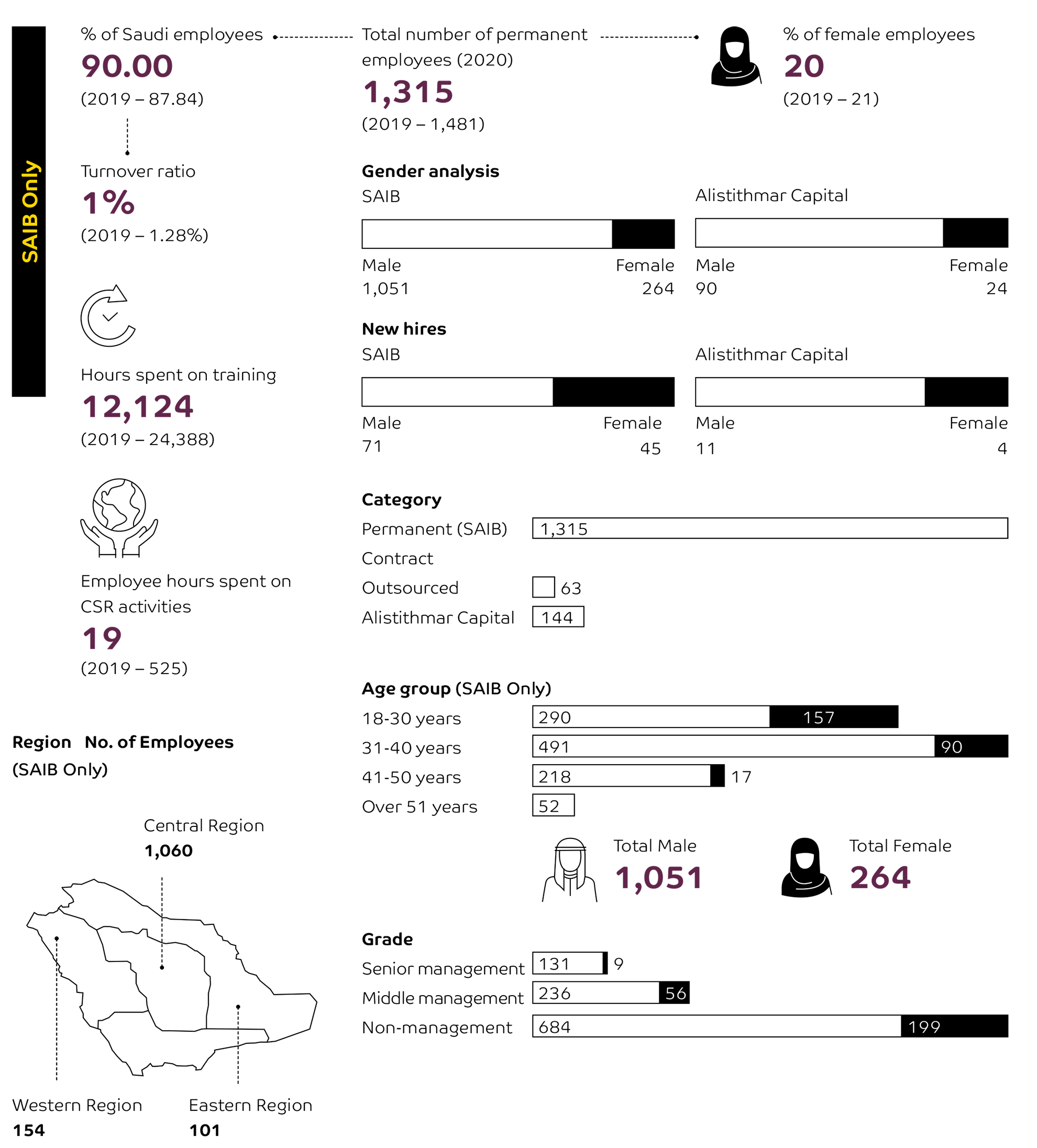
The Unit achieved a 13.23% reduction in headcount (including regular staff and out/in-sourced) with no impact on overall productivity, in line with the Bank’s objectives. Saudization increased from 87.84% in 2019 to 90% in 2020 as a result of the talent acquisition team focusing on identifying talent within the Kingdom and limiting the hiring of expatriate staff. A new talent acquisition platform was also introduced to automate requisition approval and candidate selection and approval. The unit continued to focus on upskilling employees through several initiatives including providing multiple learning platforms, developing Saudi talent, building risk and digital capability, and targeted training for certain roles.
Saudization
SAIB
Alistithmar Capital
Total
2020
2019
2018
2020
2019
2018
2020
2019
2018
Saudis (%)
90
87.84
88
80
81.90
79
89
87.44
87.7
Non-Saudis (%)
10
12.16
12
20
18.10
21
11
12.56
12.3
Automation was a major focus, with 37 processes being automated during the year. The core HR system (MenaME) was upgraded, and all workflows were revised to be streamlined with the new update, including all transactions for outsourced employees. The attendance and access control systems were revamped in accordance with the Security and Safety Department. Activities such as data clean-up and file archiving also led to cost savings for the Bank.
Male:Female salary ratio (SAIB only)
2020
2019
2018
2017
2016
Senior management
1:0.69
1:0.72
1:0.93
1:0.55
1:0.69
Middle management
1:0.23
1:0.89
1:0.83
1:0.76
1:0.86
Non-management
1:0.35
1:0.91
1:0.91
1:0.86
1:0.96
Initiatives in 2020
In what was an incredibly challenging year due to the pandemic, the Human Resources Unit at SAIB played a pivotal role in ensuring optimal workplace performance while also ensuring its performance on its strategic performance indicators was not impacted.
Several initiatives were undertaken by the HR Unit to enhance the employee experience and value to other stakeholders:
Process automation was the primary focus during the year, covering all areas of HR with a particular focus on activities which have a direct impact on the employee experience.
The core HR system was upgraded in line with the unit’s focus on process automation.
A full review of HR policies and procedure manuals in line with the Ministry of Labour’s requirements, as well as enhancing the policy.
Assess the competitiveness of employee packages in line with the market to ensure SAIB’s ability to attract and retain best-in-class talent.
Focus on employee development by providing multiple training opportunities.
The impact of these initiatives was analyzed, and the following was determined:
The initiatives directly impacted employees’ experience in dealing with HR and other HR stakeholders at large benefitted as well. Process automation has resulted in the efficient and seamless delivery of internal processes for employees and better governance of policies.
The core HR system upgrade introduced best-in-class technology within SAIB for HR processes and contributed significantly to the HR automation journey.
The review of HR policies ensured that SAIB HR practices are aligned with the Ministry of Labour’s practices and that adequate governance has been ensured. Furthermore, the policies are aligned to the Bank’s strategic initiatives.
The Bank conducted a compensation benchmarking exercise to ensure that our employees are compensated in line with market best practices and new talent is attracted to fulfil our growth ambitions.
The focus on employee development is an ongoing one, ensuring employee competitiveness even during challenging workplace events.
Future initiatives
The Bank plans to undertake several initiatives, in line with the strategic plan, related to efficiency, engagement, benefits, service standards, and internal processes. The HR Unit will continue to work on automation to accomplish the desired level of effectiveness and efficiency, in line with the Bank’s strategic objectives. Further enhancements will see the complete HR system stack being integrated, further improving the employee experience. The Unit will continue to enhance service standards and internal processes to augment value for stakeholders and be a role model for HR in the Kingdom.
Driving employee engagement will be a strategic imperative as well, keeping the best interests of employees in mind. A salary benchmark activity was completed during the year under review and the Bank will continue to carry out a benchmark on a periodic basis to ensure that its employees are compensated in line with industry trends and the Bank can continue to attract the best talent. Understanding the situation with the COVID-19 global pandemic as it evolves and adapting accordingly will also be a priority for the Unit.
Employee engagement
SAIB recognizes the importance of engaging with its employees and does so in a meaningful way to contribute to their motivation, satisfaction, and retention. Open dialogue between management and staff is maintained and a biennial employee satisfaction survey gives the Bank insight into how employees perceive their working environment and their satisfaction with performance appraisal, pay and benefits, work processes, communication, and customer focus.
With the COVID-19 pandemic and subsequent restrictions having an impact on how the Bank normally engages with its employees, a digital approach was taken in 2020 to engage with employees. Several events were successfully held virtually during the year and were well-received by the Bank’s employees.
Event
Date/Frequency
Saudi National Day celebrations
September 23, 2020
Eid celebrations
July 28, 2020
Physical activity challenges during Work from Home period
May 10, 2020
Online gaming competition amongst employees and their families
September 20, 2020
Saudi National Day
Several staff activities took place to celebrate the 90th Saudi National Day. A video was created featuring employees answering questions about topics related to the Kingdom, which was aired at an internal event to celebrate the day. The celebratory video was shared to the Bank’s social media channels. A competition was also held on LinkedIn for the Bank’s employees.
FIFA 20 tournament
An internal FIFA 20 tournament was held with the support of the Marketing Team, who organized the event by gathering participants and driving engagement numbers during the tournament.
SAIB Winter
The SAIB Winter event was held at the start of the year with the support of the Marketing and HR teams, who arranged food trucks for the event and handled internal communication with the staff to attend the event.
Motivation and retention
The Bank spent a total of SAR 672 million. on salaries and benefits in 2020 (SAIB and Alistithmar Capital).
Salaries and benefits (SAR’000)
2020
2019
2018
Fixed Compensation
415,705
390,026
417,336
Variable compensation accrued
83,000
82,000
70,000
Other employee benefits and related expenses
173,331
154,301
138,655
Total salaries and employee-related expenses
672,036
626,327
625,991
In addition to providing employees remuneration competitive with the industry rates, the Bank provides a host of benefits including life insurance, medical insurance, fitness club membership, social security, loyalty programs, and allowances for housing and transportation.
During the year, the Bank introduced new housing loan products for employees to assist them with purchasing land and self-construction. Additionally, the employee rate for personal loans was reduced from 2.41% to 1%.
Assistance is provided wherever possible to female staff members to help them balance their work and family responsibilities. Paid maternity leave up to 10 weeks and up to 180 days of sick leave is available to pregnant women.
Male
Female
Number of employees who took parental leave, by gender
67
13
Number of employees who returned to work after parental leave, by gender
67
12
Number of employees who returned to work after parental leave who were still employed 12 months after return, by gender
51
11
The return to work and retention rates of employees who returned to work after parental leave ended, by gender
2.1
1
SAIB ONLY
The Bank’s employees are also entitled to long-term benefits. Benefits payable to employees at the end of their services are accrued in accordance with guidelines set by the Saudi Labour Regulations and as per the Bank’s accounting policies. The amount of provision made during the year ended December 31, 2020 for employees’ end of service benefits was SAR 38.7 million. The balance of the accrued benefits outstanding is approximately SAR 202.4 million. as of December 31, 2020.
In addition, the Bank grants to its eligible employees other types of security and savings plans that are based on mutual contributions by the Bank and the employees. These contributions are paid to the participating employees at the respective maturity date of each plan. The amount of provision made during the year ended December 31, 2020 for these plans was approximately SAR 48.7 million.
The Bank also recognizes that besides monetary compensation, job satisfaction is equally important to its employees. A job rotation policy gives employees the opportunity to change jobs and obtain new knowledge, skills, and a broader view of the Bank’s operations, while helping to minimize discontentment as well as mitigate risk for the Bank by rotating staff in critical areas.
Learning and development
SAIB’s learning policy was revised to align more closely to the Bank’s strategic objectives. The Bank introduced a mandatory learning curriculum as per SAMA requirements. The curriculum was designed to develop the digital capability of the Bank’s employees and covers a wide range of topics, including:
Fraud prevention
Payment Card Industry Data Security Standard (PCI DSS)
Operational risk management
Acceptable usage standard
Business continuity management
Anti-money laundering and compliance
Code of Conduct
Modules focused on developing the digital capability were available to all the Bank’s employees and covered the following topics:
Introduction to Bots
Introduction to Machine Learning
Robotic Process Automation
Introduction to Artificial Intelligence
Micro Services
Basics of Data Analytics
Blockchain
Basics of the Agile Process
Internet of Things
As per SAMA’s mandate, Shariah governance and anti-money laundering (AML) was introduced for Senior Management so that they can have a complete understanding of the Bank’s Shariah governance and AML frameworks.
During 2020, six new e-learning platforms were introduced for all SAIB employees:
LinkedIn
Harvard
Moody’s
Financial Academy
Doroob
Udemy
An assessment centre conducts a psychometric analyzis of the Bank’s talent pool to identify employees with high potential using the HOGAN assessment tool to determine the strengths, motives, values, and areas for development in individuals. Furthermore, two graduate development programs were introduced.
2020
2019
2018
2017
2016
Number of training programs
159
239
192
219
Total number of participants
1,302
1,423
1,681
1,732
Training days
1,732
4,543
3,775
4,491
Hours spent on training (based on a 7-hour training day)
12,124
31,801
26,425
Number of trained staff
531
598
1,107
794
707
SAIB ONLY
Grade
Number of employees
Number of person hours of training
Male
Female
Total
Male
Female
Total
Senior management
39
4
43
651
483
1,134
Middle management
92
14
106
2,338
245
2,583
Non-management
243
139
382
5,600
2,807
8,407
SAIB ONLY
Type
Number of employees
Number of person hours of training
Male
Female
Total
Male
Female
Total
Mandatory
1,014
286
1,300
7,098
2,002
9,100
Non-mandatory
937
365
1,302
8,589
3,535
12,124
E-learning
1,036
296
1,332
7,252
2,072
9,324
SAIB ONLY
Type
2020
2019
2018
Formal training hours
12,124
30,618
26,425
Percentage of female employees (%)
30
48
25.0
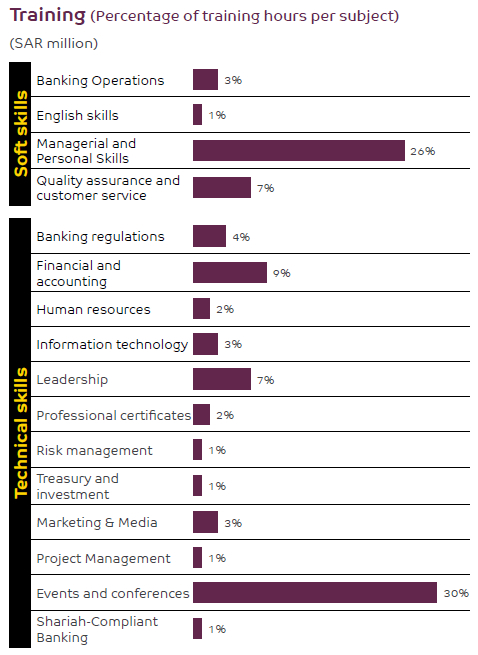
Percentage of hours – Soft skills (%)
36.49
60
74.4
Percentage of hours – Technical skills (%)
63.51
40
25.6
Percentage of hours completed by female employees (%)
29
28
32.8
Total number of participants
1,302
1,443
1,681
eLearning modules
1,332
1,261
208
SAIB ONLY
Managing the COVID-19 pandemic risks
SAIB approached the COVID-19 pandemic by enacting its business continuity plans and establishing a Coronavirus Response Team Committee comprised all department managers. In early 2020, the Committee discussed the emerging situation and immediately took to the guidelines issued by the Saudi Government regarding precautionary and preventative actions to help ensure the health and well-being of all staff, clients, and stakeholders. With the primary goal of preventing the spread of the disease, the Committee looked at how curfew times would affect the business, established staff working plans with social distancing in mind, and reallocated staff to main or alternative sites or work from home. The Committee implemented over 50 actions as a response to the coronavirus, including:
Restricting access entry for all non-staff to the head office and regional offices.
Limiting delivery and receiving of documentation at the Bank’s offices and creating specific delivery counters.
Sterilizing and disinfecting SAIB branches and departments.
Providing hand sterilizers, masks, and gloves to all SAIB staff at building entrances and within office areas.
Positioning a medical station with medical staff at entrances to conduct health and temperature checks.
Restricting access to all parking garages within the head office building and conducting temperate checks.
Providing VPN access for staff designated to work from home.
Devising staff plans to ensure only essential staff were required to work onsite.
Limiting the number of open branches and reducing working hours.
Creating educational videos advising staff on best practices for working from home.
Revisiting all critical vendors to assure their business continuity readiness.
Creating an internal procedural approach for employees to report any suspected cases of coronavirus within the staff.
Assigning staff to work from business continuity sites.
Staff who were able to work from home could do so. Thanks to the Bank’s continued focus on technology enablement, approximately 39% of the Bank’s staff were equipped to work remotely. Various critical functions that could not be performed remotely continued to operate from the Bank’s premises. Teams were split between offices and relocated to designated business continuity plan (BCP) sites and different sections within the head office.
An internal communication plan was devised to communicate news, information, and updates on health and well-being to employees. All training and business travel was prohibited as the health and safety of staff was the top priority and an increased focus was placed on sanitation and
health practices.
Occupational health and safety
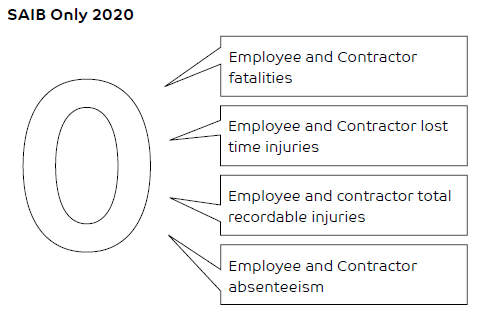
SAIB takes every step to protect the health and safety of its employees. In addition to security and safety policies, the Bank conducts branch inspections, safety sessions, and awareness programs. No fatalities, injuries, or absenteeism due to work-related health issues occurred during the year under review.
Grievance policy
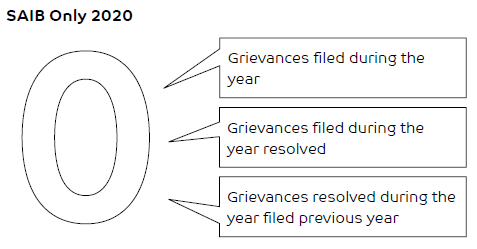
The grievance procedure is a section within the Human Resources Policy and serves as tool through which employees who may have a grievance regarding any condition of their employment to be heard by the Bank’s Management.
In the event of an employee wishing to raise a grievance, it is generally preferable for the matter to be satisfactorily resolved as close to the individual and their line manager as possible. In case this is not possible, a formal procedure is required to ensure the swift and fair resolution of the matter. A timescale to deal with the grievance swiftly is fixed but may be extended if it is agreed upon by both parties.
The grievance procedure is not intended to deal with dismissal or disciplinary matters, or disputes which are of a collective nature. If the grievance remains unresolved, the employee may choose, as a final level of appeal, to write to a dedicated email address which will be accessed by Senior Management, upon which they will receive a response within 20 working days.