SAIB’s institutional capital is made up of the intangible, non-financial assets that create value and contribute to the performance of the Bank. These assets can be the Bank’s legacy and corporate culture, its brand and values, and the vast expertise, experience, knowledge, and systems and processes it has amassed over the span of four decades.
Systems and processes
The Bank’s strategy drives the development of its systems and processes. The strategy is founded upon the Bank’s values, ethics, policies, and the sustainability pillar of Takleef (responsibility), which are also integral to the Bank’s activities. The Bank’s current three-year strategy was announced in 2019 and focuses on driving transformation to strengthen its foundation, unlock potential opportunities, and capitalize on its strengths. Digitization will play a key role in this transformation through the strengthening of the Bank’s IT capabilities, alongside agility, innovation, and strategic partnerships. The strategy also supports the financial sector development program of Vision 2030.
The Bank’s policies, systems, and procedures are subject to regular review to determine their adequacy and effectiveness within the context of the current operating environment and relevance to the Bank’s business needs.
Transformation Group
SAIB’s Transformation Group operates with the objective of shifting the function, structure, and operational model of the Bank’s departments and align them with its strategy and goals. In 2020, the Group implemented several initiatives to enable the successful implementation of the Bank’s strategy and directives.
Numerous transformation projects aimed at departments, processes, and product enhancement were undertaken by embracing the latest digitization and automation methods, in line with the Bank’s strategy. Processes were optimised through the application of Agile and Six Sigma practices and capacity planning was used to define the ideal manpower requirements.
The Group established value added partnerships with key market players and fintech partners to enrich the Bank’s overall offerings to its most sought-after segments.
The Group also supported various functions through artificial intelligence and data science initiatives. These initiatives aimed to improve business intelligence and leverage improvements in big data to achieve operational targets and strategic goals.
IT transformation strategy
With the push towards digital and online services in a year where the pandemic severely limited the ability of people to move about and interact face to face, transforming the Bank’s services while ensuring the security of its systems and information was more critical than ever.
The Information Technology Group (ITG) carried out projects and initiatives aligned to the Bank’s three-year strategy and transformation programs. ITG focused primarily on enabling flexible infrastructure and innovative business solutions to meet growing business demands, rising cost of capital, compliance with increasingly stringent local and international regulatory requirements, and the Board of Directors’ mandate to support long-term sustainability and effective governance. ITG also initiated the execution of the three-year IT strategy that will see it define the digital and strategic direction for better enablement and alignment with the Bank’s business strategy.
In response to the pandemic, ITG provided more collaboration tools to enable remote working for the Bank’s employees and provided the necessary technical support to facilitate the allocation of employees to different business continuity centres by upgrading the Bank’s network and providing extra bandwidth. ITG continued to complete other major enhancements to existing systems as part of the Bank’s continuous improvement initiatives.
During 2020, ITG completed several initiatives including:
New API management solutions to serve agent banking and all other fintech initiatives.
Strengthening IT capabilities in digital experience and acquisition through digital wallets, artificial intelligence (AI), and data analytics.
Launching as the first bank in the Kingdom to have full integration with the Saudi Ministry of Justice for electronic promissory notes (e-SANAD).
Enabling all SAIB credit cards (Visa/MasterCard) to work with Apple Pay and mada Pay.
Implementation of major collaboration tools to support remote working environment and communication with external parties in response to COVID-19.
SAMA-mandated disaster recovery testing with an excellent record for recovery time.
SAMA-mandated critical projects for 2020 including but not limited to COVID-19 requirements, Tanfeeth phase 2, SADAD ESAL, cards schemas, SATR reporting.
Enhanced integration capabilities to allow smooth integration with all e-government services including REDF, Bayan, GOSI, Tabadul, MOJ, and other third-party service providers.
Major enhancements for the Trade Finance System.
Private banking 360 Module for private customers.
Travel card services improvement via the internet banking channel to enable customers to add up to 100 currencies and manage their wallets online.
Enhance the WOOW loyalty program by integrating several e-voucher providers to facilitate the smooth and easy redemption of rewards.
Introduce the electronic customer update (e-KYC) for individual customers on the digital channels (mobile and internet).
Adopt for the first time the Virtual Desktop Infrastructure (VDI) which will accelerate the deployment of services.
Enhance the monitoring capabilities for cards and payment-related systems.
Launch the new home equity loan.
Introduce new SMS gateway with maximum availability to support all digital services with no interruption.
Improve critical systems performance processing time.
Implementation of several new business solutions for Treasury, Personal Banking, Corporate Banking, Finance, HR, Risk, Information Security, Business Continuity, and Marketing.
All IT procedures and projects are carried out in compliance with the Bank’s IT policies and follow internationally accepted best practices including ISO 20000, project management frameworks, and IT architecture and cybersecurity standards.
The Bank was awarded the ISO 22301:2019 certificate by the International Organization for Standardization (ISO) for adhering to the updated standards of Business Continuity Management System (BCMS).
Microsoft Power BI platform
As part of its digital journey and in alignment with Vision 2030, SAIB added Microsoft’s Power BI to its ecosystem of Microsoft products. The platform will aid SAIB’s digitalisation initiative that aims to enrich the customer experience and enhance transparency within the Organization by helping it to rationalise its operations, accelerate its digital journey, improve the handling of data, enhance the understanding of customer needs, and make better informed decisions in finance and operations.
With the integration of Microsoft Power BI and segmentation of data, SAIB can obtain an enhanced perspective of customer behaviour, which leads to improved efficiency. Through the enhanced analysis of transactions and customers’ activities and interactions with the Bank, SAIB can react promptly and provide its customers with relevant products and services at the right time. This focuses on the customer experience has benefitted customer acquisition and the upselling of products and services to the customer base, as well as provide actionable insights on consumer behaviour.
Sustainability Management Dashboard System
SAIB invests in technology to enable the delivery of timely and relevant insights that facilitates the Bank’s Management in their activities and critical decision-making. The innovative Sustainability Management Dashboard System (SMDS) collects, stores, analyses, and delivers information on a monthly or quarterly basis and processes it for key decision-makers to supplement the decision-making process. The information reported against is closely aligned to the Global Reporting Initiative (GRI) standards. Through the SMDS, the key decision-makers can regularly track and report performance against the Bank’s sustainability goals.
Awards and recognition
During 2020, the Bank received a number of
awards, including:
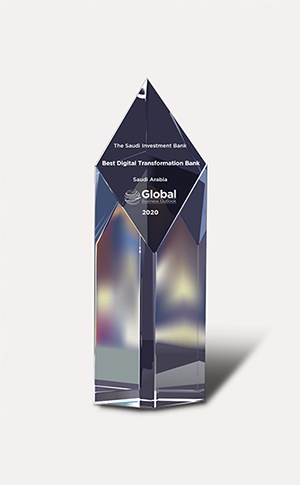
Best Digital Transformation Bank – 2020 Saudi Arabia awarded by Global Business Outlook
Best International Travel Card – 2020 Saudi Arabia awarded by Global Business Outlook