GRI 103-1, 103-2, 103-3, 205-1, 205-2
SAIB’s Compliance function plays a critical role in upholding the Bank’s reputation and integrity by ensuring adherence to all applicable laws, regulations, policies, and rules. SAIB’s corporate culture has been established around compliance and employees at all levels understand its importance and how they play a role in upholding it. The Board of Directors and Executive Management assign the highest priority to the Compliance function.
The compliance program is based on the Compliance Manual for Banks operating in the Kingdom of Saudi Arabia issued by SAMA in December 2008. The Compliance Manual details compliance functions and all related policies, processes, and plans as approved by the Board of Directors. The General Manager of Compliance Group is responsible for administering the program, which is periodically revised to adapt to changes in laws and regulations, changes in functions and business processes, changes in Organization Structure, and changes in job roles.
Compliance Group
The Compliance Group is an independent group that ensures the Bank’s compliance with applicable laws, regulations, and rules, and therefore plays an essential role to preserve the integrity and reputation of the Bank.
Responsibilities
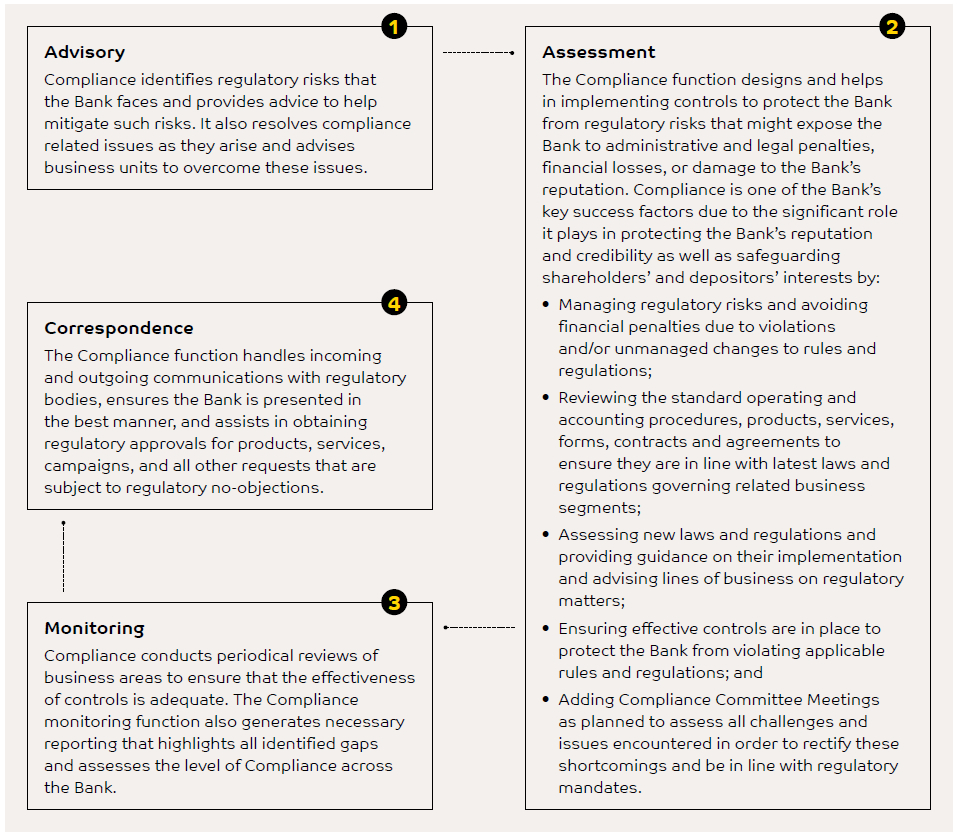
Compliance initiatives of SAIB
Anti-Money Laundering and Counter Terrorist Financing Department
The Anti-Money Laundering (AML) and Counter Terrorist Financing (CTF) Department is an independent
department that reduces the risk of money laundering and terrorist financing by setting the Bank’s AML programs, and policies and procedures to comply with local and international standards.
Responsibilities of the AML and CTF Department include:
- Monitoring and identifying suspicious transactions, performing investigations, classifying suspicious activities, and reporting them to the General Administration of Financial Investigation.
- Reviewing products and services from a regulatory viewpoint and on a risk approached basis.
- Ensuring that enhanced due diligence is applied in all cases warranted to mitigate AML exposure.
- Monitoring and managing high risk accounts and related activities.
- Maintaining a sanction system and related controls.
- Identifying hits which require additional research.
- Ensuring hits/alerts are handled in line with established procedures and meet the standards for both quality and timeliness.
- Monitoring and assisting in the resolution of complex issues.
- Implementing SAMA directives related to deduction and blocking and unblocking of bank accounts.
- Preparing necessary technical reports in a timely manner and providing all required documents to SAMA.
Anti-Fraud, Anti-Bribery, and Corruption Department
Financial crimes are considered a significant risk for financial institutions and related stakeholders and the occurrence of such crimes can have significant negative financial and reputational impacts.
Measures against financial crimes (including frauds, bribery and corruption) are managed by the Anti-Fraud, Anti-Bribery and Corruption Department that operates within the Compliance Group. The Anti-Fraud, Anti-Bribery and Corruption Department continuously enhances the Bank’s fraud risk policies and procedures in response to emerging trends and regulations for financial crimes against financial services businesses. Relevant and contemporary measures have been put in place to ensure detection, prevention, monitoring and reporting of financial crimes against the Bank and its stakeholders.
The Anti-Fraud, Anti-Bribery and Corruption Department presents its findings and recommended action to Audit Committee quarterly.
Human resources policy
The integrity of the Bank’s employees is critical to ensuring compliance. The Bank screens all prospective employees for past professional conduct during the recruitment process. All supervisors observe compliance issues when monitoring their direct reports. The adherence of employees to the Bank’s compliance policies is considered in staff appraisals at all levels. Employees who develop and maintain systems and procedures are kept updated along with other employees on the latest developments in compliance requirements. The General Manager of the Compliance Group is responsible for implementing any new laws and regulations. The Compliance function remains vigilant over conflicts of interest among Compliance staff and other departments.